The following statement comes from The Evangelical Manifesto: A Declaration of Evangelical Identity and Public Commitment and was published in May of 2008. The whole manifesto is worth reading, but I was particularly struck by the following passage which details the need for Evangelicals to be radically refashioned in their own life and witness. It conforms to my own beliefs and views regarding the Church and culture:
Our second major concern [as Evangelicals] is the reformation of our behavior. We affirm that to be Evangelical or to carry the name Evangelicals is not only to shape our faith and our lives according to the teaching and standards of the Way of Jesus, but to need to do so again and again. But if the Evangelical impulse is a radical, reforming, and innovative force, we acknowledge with sorrow a momentous irony today. We who time and again have stood for the renewal of tired forms, for the revival of dead churches, for the warming of cold hearts, for the reformation of corrupt practices and heretical beliefs, and for the reform of gross injustices in society, are ourselves in dire need of reformation and renewal today.
Reformers, we ourselves need to be reformed. Protestants, we are the ones against whom protest must be made.
We confess that we Evangelicals have betrayed our beliefs by our behavior.
All too often we have trumpeted the gospel of Jesus, but we have replaced biblical truths with therapeutic techniques, worship with entertainment, discipleship with growth in human potential, church growth with business entrepreneurialism, concern for the church and for the local congregation with expressions of the faith that are churchless and little better than a vapid spirituality, meeting real needs with pandering to felt needs, and mission principles with marketing precepts. In the process we have become known for commercial, diluted, and feel-good gospels of health, wealth, human potential, and religious happy talk, each of which is indistinguishable from the passing fashions of the surrounding world.
All too often we have set out high, clear statements of the authority of the Bible, but flouted them with lives and lifestyles that are shaped more by our own sinful preferences and by modern fashions and convenience.
All too often we have prided ourselves on our orthodoxy, but grown our churches through methods and techniques as worldly as the worldliest of Christian adaptations to passing expressions of the spirit of the age.
All too often we have failed to demonstrate the unity and harmony of the body of Christ, and fallen into factions defined by the accidents of history and sharpened by truth without love, rather than express the truth and grace of the Gospel.
All too often we have traced our roots to powerful movements of spiritual revival and reformation, but we ourselves are often atheists unawares, secularists in practice who live in a world without windows to the supernatural, and often carry on our Christian lives in a manner that has little operational need for God.
All too often we have attacked the evils and injustices of others, such as the killing of the unborn, as well as the heresies and apostasies of theological liberals whose views have developed into “another gospel,” while we have condoned our own sins, turned a blind eye to our own vices, and lived captive to forces such as materialism and consumerism in ways that contradict our faith.
All too often we have concentrated on great truths of the Bible, such as the cross of Jesus, but have failed to apply them to other biblical truths, such as creation. In the process we have impoverished ourselves, and supported a culture broadly careless about the stewardship of the earth and negligent of the arts and the creative centers of society.
All too often we have been seduced by the shaping power of the modern world, exchanging a costly grace for convenience, switching from genuine community to an embrace of individualism, softening theological authority down to personal preference, and giving up a clear grasp of truth and an exclusive allegiance to Jesus for a mess of mix-and-match attitudes that are syncretism by another name.
All too often we have disobeyed the great command to love the Lord our God with our hearts, souls, strength, and minds, and have fallen into an unbecoming antiintellectualism that is a dire cultural handicap as well as a sin. In particular, some among us have betrayed the strong Christian tradition of a high view of science, epitomized in the very matrix of ideas that gave birth to modern science, and made themselves vulnerable to caricatures of the false hostility between science and faith. By doing so, we have unwittingly given comfort to the unbridled scientism and naturalism that are so rampant in our culture today.
All too often we have gloried in the racial and ethnic diversity of the church around the world, but remained content to be enclaves of separateness here at home.
All too often we have abandoned our Lord’s concern for those in the shadows, the twilight, and the deep darkness of the world, and become cheerleaders for those in power and the naïve sycophants of the powerful and the rich.
All too often we have tried to be relevant, but instead of creating “new wineskins for the new wine,” we have succumbed to the passing fashions of the moment and made noisy attacks on yesterday’s errors, such as modernism, while capitulating tamely to today’s, such as postmodernism.
We call humbly but clearly for a restoration of the Evangelical reforming principle, and therefore for deep reformation and renewal in all our Christian ways of life and thought.
We urge our fellow-Evangelicals to go beyond lip-service to Jesus and the Bible and restore these authorities to their supreme place in our thought and practice.
We call our communities to a discerning critique of the world and of our generation, so that we resist not only their obviously alien power but the subtle and seductive shaping of the more brilliant insights and techniques of modernity, remembering always that we are “against the world, for the world.”
We call all who follow Jesus to keep his commandment and love one another, to be true to our unity in him that underlies all lesser differences, and to practice first the reconciliation in the church that is so needed in the wider world. In a society divided by identity and gender politics, Christians must witness by their lives to the way their identity in Jesus transcends all such differences.
We call for an expansion of our concern beyond single-issue politics, such as abortion and marriage, and a fuller recognition of the comprehensive causes and concerns of the Gospel, and of all the human issues that must be engaged in public life. Although we cannot back away from our biblically rooted commitment to the sanctity of every human life, including those unborn, nor can we deny the holiness of marriage as instituted by God between one man and one woman, we must follow the model of Jesus, the Prince of Peace, engaging the global giants of conflict, racism, corruption, poverty, pandemic diseases, illiteracy, ignorance, and spiritual emptiness, by promoting reconciliation, encouraging ethical servant leadership, assisting the poor, caring for the sick, and educating the next generation. We believe it is our calling to be good stewards
of all God has entrusted to our care so that it may be passed on to generations yet to be born.
We call for a more complete understanding of discipleship that applies faith with integrity to every calling and sphere of life, the secular as well as the spiritual, and the physical as well as the religious; and that thinks wider than politics in contributing to the arts, the sciences, the media, and the creation of culture in all its variety.
Above all, we remind ourselves that if we would recommend the Good News of Jesus to others, we must first be shaped by that Good News ourselves, and thus ourselves be Evangelicals and Evangelical.
Showing posts with label Christianity. Show all posts
Showing posts with label Christianity. Show all posts
Tuesday, December 08, 2009


Friday, April 03, 2009
David Simon, Angst and New Life
David Simon, the journalist, author and writer/producer of the acclaimed show The Wire was in Greencastle last night. He was the invited guest for a conference on the future of journalism (for future journalists), and I went. The two episodes of The Wire I had seen were great works. But really hooked me was David's title for the lecture ... The Audacity of Despair: The Decline of the American Empire and What's In it For You.
I should have known by the title alone that David was going to be rather audacious in his persona, but I half expected an outlandish title with a blaisse conversation. As a pastor, I know it's easier to write bold words than it is to speak or embody them.
Turns out the title was rather innocent compared to David Simon.
The man was refreshingly honest (and openly crass ... so, let me add a warning ... if you do read his books or watch his shows or hear him speak, please do not think I'm endorsing his language or harshness. But I do appreciate his honesty). In fact his honesty was so strong that the whole audience began to skirm in their chairs no more than five minutes after he opened his mouth. He got to us. He got to me.
Now, granted: what he was saying was not something I wanted to hear (I'll share his thoughts here in a second). But, who he was and how he was embodying his belief was inspiring. Here he was ... someone who had been a journalist, someone who cared deeply about his home city of Baltimore, someone who is serious with life enough to live in the face of real injustice and crime ... willing to speak passionately about justice and injustice. He said plainly ... over and over again ... we do not want to face the facts. As Americans, we have grown accustomed to comfort over truth.
What he is is a prophet, at least in the biblical sense of the word. The biblical prophets - like Jeremiah and Ezekiel - made the people of God face reality, even when the reality wasn't easy. That's what David Simon was trying to say last night. He was saying, "we can do better; we have not done our best." I could not believe how open he was about it.
And that gets me to what you want to hear ... which is what he said.
David Simon's main point is that we've been making crap in this country for thirty years and expecting gold (except he didn't say crap). He said we've been living out of other people's pockets instead of developing our own communities (the key line in The Wire by David's own admission is when one guy says, "we haven't made anything in this country for thirty years ... we use to make stuff."). He said we've become a culture of individual promotion to the exlusion of community benefit. He said we've become so obsessed with "statistics" that we can stare glaring truths right in our face and claim they are not true ("There are 60 ways to make statistics lie so it looks like crime is going down," he said. "I know. Having worked in crime journalism for thirteen years, I've seen 58 ways."). He said we've lost any sense of professional integrity that will hold us to a task for a sustained period - longing instead for quick promotion and 36% margins of profit.
(If you would like to get a sampling of his thoughts, click here ... it's an article about the show The Wire, but at the end is the full transcript of the interview).
So, here's what I agree with David about ...
1. We have seen capitalism run afoul and personal promotion triumph over community welfare.
2. We've seen the triumph of "statistics" and "information" over pure reason and moral sense ... interestingly this is the exact point Edward Friedman made about American culture, and like David Simon, Friedman suggests that despite our "technological" advances our culture is in regression.
3. The only way to really stem this problem is to cease reliance or belief that someone "outside" of the situation is going to fix it and to begin working where we are (i.e. locally) to figure out what is not working and what will work.
4. The birth of the global news network has limited the ability for individuals to speak truth to power (much of David's talk reminded me of that great movie Network and the dangers of making our news sources "profitable" for or because of entertainment).
5. We are eating our young (as Parker Palmer says) by demanding unrealistic growth out of our investments, our businesses, and in our life.
6. We cannot expect a "hero" to save us from our ills - whether that hero is a politician, a product, a technology or a movement. Only a return to honest work over a sustained period of time will save us.
7. Life is essentially tragic, and - as David said - we can learn alot about how to live by re-engaging the tragedies of Shakespeare and Greek drama. We too need to learn how to be human even in the face of tragedy.
On the other hand, here is where I would differ from David Simon:
1. While life is indeed tragedy, it is also - as Frederick Buechner says - comedy and fairy tale and we haven't told the whole truth until we acknowledge the personal, intimate way God deals with the suffering of the world through Jesus Christ.
2. While I agree that David's anger is largely justifiable, I do not agree that anger is what will solve our community and national problems. I believe righteous indignation can be a spark for progress, but I also believe that radical movements throughout history that are sustained by anger instead of love and self-sacrifice end up becoming corrupted by the very power they seek to be rid of.
3. A return to sound reporting is not the answer ... the answer is in the work of the Holy Spirit guiding persons of faith to immerse themselves in the tragedy and problems of their community, trusting that God will bring new life into the misery through love, hope and faith. And, more often than not (if not all the time), such virtuous living in the face of ongoing danger, exploitation and power does not win. It is killed, only to be resurrected by God in a triumph of humility. Such is the way of Christ and the followers of Jesus Christ. What gives life to community is the willingness of individuals courageously seeking the good of others ... even when it limits or hurts their own life.
But, still, it takes someone with courage and hootzpa to at least say, like David Simon and Peter Beale ... "I'm mad as hell and I'm not going to take it anymore." In fact, as Eugene Peterson says, rejection of the world is and always has been the place where we begin our journey back to God and goodness begins:
"A person has to be thoroughly disgusted with the way things are to find the motivation to set out on the Christian way. As long as we think the next election might eliminate crime and establish justice or another scientific breakthrough might save the environment or another pay raise might push us over the edge of anxiety into a life of tranquillity, we are not likely to risk the arduous uncertainties of the life of faith. A person has to get fed up with the ways of the world before he, before she, acquires an appetite for the world of grace." (A Long Obedience in the Same Direction: Discipleship in an Instant Society)
So, thank you, David, for increasing my appetite for the world of grace. And, Jesus: may you strengthen me to engage this tragic world so that I too - like you - might experience the divine comedy of God's love and grace.
Wes
I should have known by the title alone that David was going to be rather audacious in his persona, but I half expected an outlandish title with a blaisse conversation. As a pastor, I know it's easier to write bold words than it is to speak or embody them.
Turns out the title was rather innocent compared to David Simon.
The man was refreshingly honest (and openly crass ... so, let me add a warning ... if you do read his books or watch his shows or hear him speak, please do not think I'm endorsing his language or harshness. But I do appreciate his honesty). In fact his honesty was so strong that the whole audience began to skirm in their chairs no more than five minutes after he opened his mouth. He got to us. He got to me.
Now, granted: what he was saying was not something I wanted to hear (I'll share his thoughts here in a second). But, who he was and how he was embodying his belief was inspiring. Here he was ... someone who had been a journalist, someone who cared deeply about his home city of Baltimore, someone who is serious with life enough to live in the face of real injustice and crime ... willing to speak passionately about justice and injustice. He said plainly ... over and over again ... we do not want to face the facts. As Americans, we have grown accustomed to comfort over truth.
What he is is a prophet, at least in the biblical sense of the word. The biblical prophets - like Jeremiah and Ezekiel - made the people of God face reality, even when the reality wasn't easy. That's what David Simon was trying to say last night. He was saying, "we can do better; we have not done our best." I could not believe how open he was about it.
And that gets me to what you want to hear ... which is what he said.
David Simon's main point is that we've been making crap in this country for thirty years and expecting gold (except he didn't say crap). He said we've been living out of other people's pockets instead of developing our own communities (the key line in The Wire by David's own admission is when one guy says, "we haven't made anything in this country for thirty years ... we use to make stuff."). He said we've become a culture of individual promotion to the exlusion of community benefit. He said we've become so obsessed with "statistics" that we can stare glaring truths right in our face and claim they are not true ("There are 60 ways to make statistics lie so it looks like crime is going down," he said. "I know. Having worked in crime journalism for thirteen years, I've seen 58 ways."). He said we've lost any sense of professional integrity that will hold us to a task for a sustained period - longing instead for quick promotion and 36% margins of profit.
(If you would like to get a sampling of his thoughts, click here ... it's an article about the show The Wire, but at the end is the full transcript of the interview).
So, here's what I agree with David about ...
1. We have seen capitalism run afoul and personal promotion triumph over community welfare.
2. We've seen the triumph of "statistics" and "information" over pure reason and moral sense ... interestingly this is the exact point Edward Friedman made about American culture, and like David Simon, Friedman suggests that despite our "technological" advances our culture is in regression.
3. The only way to really stem this problem is to cease reliance or belief that someone "outside" of the situation is going to fix it and to begin working where we are (i.e. locally) to figure out what is not working and what will work.
4. The birth of the global news network has limited the ability for individuals to speak truth to power (much of David's talk reminded me of that great movie Network and the dangers of making our news sources "profitable" for or because of entertainment).
5. We are eating our young (as Parker Palmer says) by demanding unrealistic growth out of our investments, our businesses, and in our life.
6. We cannot expect a "hero" to save us from our ills - whether that hero is a politician, a product, a technology or a movement. Only a return to honest work over a sustained period of time will save us.
7. Life is essentially tragic, and - as David said - we can learn alot about how to live by re-engaging the tragedies of Shakespeare and Greek drama. We too need to learn how to be human even in the face of tragedy.
On the other hand, here is where I would differ from David Simon:
1. While life is indeed tragedy, it is also - as Frederick Buechner says - comedy and fairy tale and we haven't told the whole truth until we acknowledge the personal, intimate way God deals with the suffering of the world through Jesus Christ.
2. While I agree that David's anger is largely justifiable, I do not agree that anger is what will solve our community and national problems. I believe righteous indignation can be a spark for progress, but I also believe that radical movements throughout history that are sustained by anger instead of love and self-sacrifice end up becoming corrupted by the very power they seek to be rid of.
3. A return to sound reporting is not the answer ... the answer is in the work of the Holy Spirit guiding persons of faith to immerse themselves in the tragedy and problems of their community, trusting that God will bring new life into the misery through love, hope and faith. And, more often than not (if not all the time), such virtuous living in the face of ongoing danger, exploitation and power does not win. It is killed, only to be resurrected by God in a triumph of humility. Such is the way of Christ and the followers of Jesus Christ. What gives life to community is the willingness of individuals courageously seeking the good of others ... even when it limits or hurts their own life.
But, still, it takes someone with courage and hootzpa to at least say, like David Simon and Peter Beale ... "I'm mad as hell and I'm not going to take it anymore." In fact, as Eugene Peterson says, rejection of the world is and always has been the place where we begin our journey back to God and goodness begins:
"A person has to be thoroughly disgusted with the way things are to find the motivation to set out on the Christian way. As long as we think the next election might eliminate crime and establish justice or another scientific breakthrough might save the environment or another pay raise might push us over the edge of anxiety into a life of tranquillity, we are not likely to risk the arduous uncertainties of the life of faith. A person has to get fed up with the ways of the world before he, before she, acquires an appetite for the world of grace." (A Long Obedience in the Same Direction: Discipleship in an Instant Society)
So, thank you, David, for increasing my appetite for the world of grace. And, Jesus: may you strengthen me to engage this tragic world so that I too - like you - might experience the divine comedy of God's love and grace.
Wes
Thursday, January 15, 2009
Waterdeep
Don and Lori Schafer have been making music for years together under various band names and in conjunction with other artists. They comprise part of the worship musicians who have brought forth the many "Enter the Worship Circle" albums in the last fifteen years.
I thoroughly appreciate their work and have benefited from it tremendously, and I think their work is especially admirable given the rising popularity of Christian worship music in the last two decades. Don and Lori have managed to maintain a devotion to God first, and their music has continued to stretch itself in an attempt to expand their own faith. I think - if you read the bio for one of Don and Lori's bands (Waterdeep), you will see the maturity and care that goes into their music and - consequently - their message.
So, clearly, I enjoy their stuff. Well, today, I listened to a song of Waterdeep's that came out several years ago. As can often happen, I had heard the song several times, but the lyrics final caught my ear and the message entered my soul.
The song is titled "Take Me", and it is the story of how we learn to let go of our "earthly tents" in the process of aging so that our souls might be released and our bodies restored. Here are the lyrics to that song:
“Old ain’t a word that I’m fond of,” he said.
“And these days I’ve begun to lose count.”
Mumbling she rolls in her wheelchair, and says,
“I’m afraid that they’ve closed my account.”
There’s a blur that occurs in the line of their life
That decays the whole notion of sense
And they call to the past, insisting that it last,
While they’re climbing down reality’s fence
Singing with me
Take me
Take me
Write my name in the most Holy Tome
And when it’s my time
To assume the sublime,
Take me to my promised home
And their hands aren’t gnarled, they’re in love with the earth
And they’re dying to go there again
We say the essence of life is strong in our youth,
Slowly buried under wrinkles of skin
But there’s God in the way that life comes to an end,
In the way that it draws to a close,
In the saying of soul to the house of the skin,
You’re too weak now to really oppose
I thoroughly appreciate their work and have benefited from it tremendously, and I think their work is especially admirable given the rising popularity of Christian worship music in the last two decades. Don and Lori have managed to maintain a devotion to God first, and their music has continued to stretch itself in an attempt to expand their own faith. I think - if you read the bio for one of Don and Lori's bands (Waterdeep), you will see the maturity and care that goes into their music and - consequently - their message.
So, clearly, I enjoy their stuff. Well, today, I listened to a song of Waterdeep's that came out several years ago. As can often happen, I had heard the song several times, but the lyrics final caught my ear and the message entered my soul.
The song is titled "Take Me", and it is the story of how we learn to let go of our "earthly tents" in the process of aging so that our souls might be released and our bodies restored. Here are the lyrics to that song:
“Old ain’t a word that I’m fond of,” he said.
“And these days I’ve begun to lose count.”
Mumbling she rolls in her wheelchair, and says,
“I’m afraid that they’ve closed my account.”
There’s a blur that occurs in the line of their life
That decays the whole notion of sense
And they call to the past, insisting that it last,
While they’re climbing down reality’s fence
Singing with me
Take me
Take me
Write my name in the most Holy Tome
And when it’s my time
To assume the sublime,
Take me to my promised home
And their hands aren’t gnarled, they’re in love with the earth
And they’re dying to go there again
We say the essence of life is strong in our youth,
Slowly buried under wrinkles of skin
But there’s God in the way that life comes to an end,
In the way that it draws to a close,
In the saying of soul to the house of the skin,
You’re too weak now to really oppose
Monday, December 22, 2008
What I Am Reading

Invitation to a Journey: A Road Map for Spiritual Formation. Today: the eighth chapter, "The Classical Spiritual Pilgrimage". And on this journey there are - so the wisdom of generations tells me - four stages: awakening, purging, illumination and union. And in this ongoing process of learning to be "in Christ" is the ebb and flow of learning to trust ...
"This yieldedness to God is the 'trust' Groeschel describes as the deepest of the stages of purgation. It is trust that rests one's being totally and completely in God's love and care without demands, conditions or prior expectations. Even in the darkness of God's seeming absence, trust rests the weight of one's being absolutely in God. The psalmist captures this deep inner posture of trust in Psalm 131:
O Lord, my heart is not proud
nor haughty my eyes.
I have not gone after things too great
nor marvels beyond me.
Truly I have set my soul
in silence and peace.
A weaned child on its mother's breast,
even so is my soul.
"The first affirmation expresses the absence of self-concerned anxiety. Then, in the image of the weaned child at its mother's breast, the psalmist reveals the life of absolute trust in God. The unweaned child is at its mother's breast for its own need, its own agenda - milk. The weaned child, however, has no such need or agenda. It is content to rest in the mother's arms and receive whatever attention she chooses to give."
Thursday, August 14, 2008
Honoring The Body

"In the beginning was the Word, and the Word was with God, and the Word was God … And the Word became flesh and lived among us …”
John 1
"Your body is a temple of the Holy Spirit within you …” Paul to the Corinthian believers
“Matter is real. Flesh is good,” the wise pastor tells us, “without a firm rooting in creation, religion is always drifting off …The Word did not become a good idea, or a numinous feeling, or a moral aspiration; the Word became flesh.”1 This is such an important point that both the beginning of the Old Testament (Genesis) and the New Testament (the Gospels) begin by telling us plainly God has blessed and honored the created world. We cannot practice our faith by bypassing our bodies and moving into our heads or our souls. We must begin where God begins: with the matter of creation, with our very bodies.
There is something incredible about our bodies … no doubt about that. The intricacy of nerves and synapse, the unbelievable complexity of all that our bodies do every minute to sustain and produce life, the coordination between eyes and hands: all bespeak of God’s amazing design. But, just as our bodies speak of life, when we truly consider them, they also teach us something else.
Our bodies teach us the sacredness of vulnerability, the holiness of finitude. We live as temples of flesh and blood, flesh that ages, blood that can spill. You realize that when you hold a baby, when you care for a dying parent. Stephanie Paulsell who wrote the article “Honoring the Body” for the book Practicing Our Faith emphasizes this sacredness in our vulnerability, a fact we frequently do recognize while holding babies. But, the sacredness of our condition doesn’t just end with swaddling blankets. Our bodies are at all times in need of care, of nutrition, of protection. Our bodies are at all times marching towards the cessation of life. From dust we came, to dust we shall return our ancestors remind us.
Many people, though, prefer to ignore that reminder and run from their vulnerability and finitude. Christianity itself has not been immune from such tendencies. In fact, in the 2nd Century a type of theological mid-life crisis occurred. Certain believers began to question the sacredness of flesh and blood. They tried to mask God-realities of blessed creation by dividing life into matter (bad) and spirit/wisdom (good). Gnosticism was its name, and while Gnosticism was declared heresy on several occasions that hasn’t stopped the same thought from creeping up again and again. It’s not all that uncommon to hear a devout soul exclaim the word “flesh” in a vile and repugnant tone. And we can’t forget that even the great apostle Paul opened the door to such division when he declared that terrible conflict between “spirit” and “flesh” (Romans 7).
But, despite all that, here we are. We are human beings. We have eyes and ears, limbs and organs. While we may prefer to have other materials to work with, there are none. As the poet Jane Kenyon tells us our life is a “long struggle to be at home in the body, this difficult friendship.”
Many of us don’t do very well with this friendship. We compare our bodies to the images we see on television or those printed in magazines. We wonder why God has given us too much of this or not enough of that. We curse our bodies for failing us, for straining against us even when we seek to do them well by exercising.
Learning to Honor the Body in Community
Perhaps this is why honoring the body is a practice that is best learned in community. In community we discover this paradox: often we learn to care and honor our body when we cease to focus on our bodies and focus instead on the needs of others. This is where the sacredness of vulnerability becomes essential again.
Seeing Christ in Others … and In Us
When we take time to consider those around us, to see them as real, matter-of-fact people with real needs, real beauty and real blemishes, we begin to see the godliness in those persons. That even includes the sacredness of the wounded. In fact, the more we allow ourselves to see wounded or handicapped persons as human beings, the more apt we are to see the world with godly compassion. Paulsell explains: “The practice of honoring the body keeps these wounded bodies visible not as objects but as persons made in God’s image. The practice of honoring the body leads us to prophetic action by forming us as persons who love every human body and the ravaged body of earth itself.” It is this same prophetic seeing that Jesus invited when he encouraged the disciples to go out and feed and clothe those in need (Matthew 25).
Jesus’ words are especially important. They demonstrate that any gospel that seeks to divorce itself from the body (from real people with real needs) is empty. And just as important: Jesus’ very life proved God’s recognition of both the sacredness of the material and the necessity to redeem us fully—including our bodies. Christ came bodily and Christ was resurrected bodily. Christianity is, as Paulsell declares, an “embodied” faith.
The Body in Worship
The Christian Church has also sought to marry both soul and body in distinct worship practices. In fact, Christian worship is itself intended to honor the body. Worship is corporeal: “in the meal of communion, we eat and drink, gathered together by Christ’s own wounded body; in baptism, it is our bodies that are bathed in cleansing water; in the passing of the peace, we touch one another in love and hope” (Paulsell, 16). But it is not just the Lord’s Supper, baptism and the passing of the peace that makes worship corporeal. All of worship demands our faculties. It is impossible to worship God without first recognizing the role our bodies play.
So as you prepare to worship this Sunday, take a moment to consider those who will gather with you, the body of Christ. While you don’t have to stare, do notice them. Then, locate the baptismal font and the communion table. And invite the Holy Spirit to give you an awareness of God’s presence, to help you understand more fully the psalmist's expression: “taste and see the Lord is good” (Psalm 34:8). 2
1 Peterson, Eugene. The Contemplative Pastor. Pg. 68.
2 This article is heavily influenced by Paulsell’s article and the quote from Jane Kenyon also comes from her work in the book Practicing Our Faith.
Wednesday, August 13, 2008
(Re)reading the Bible
I began reading John Thompson's Reading the Bible with the Dead: What You Can Learn from the History of Exegesis that You Can't Learn from Exegesis Alone tonight, which is a fabulous book, even if you don't know what the word "exegesis" means (okay, so now you're curious: exegesis).
John Thompson is the professor of historical theology and the Gaylan & Susan Byker Professor of Reformed Theology at Fuller Theological Seminary. He is also the same man who taught me how to navigate the steep descents of the Los Angeles National Forest on a mountain bike and the man who taught me Reformed history. Needless to say, I mastered the first endeavor about as well as the second, and I came no where close to the proficiency, skill and artistry that John did with both disciplines.
On top of that, John and his wife Marianne Meye Thompson, helped guide me through my final years of seminary and helped prepare me for pastoral ministry - a transition that is much more difficult than what you might expect or hope for pastors.
All that to say, I was deeply thankful to pick up John's book and to sink my teeth into something I knew would be judicious, hilarious, insightful and devoted to seeking God's word above all. And, I have not been disappointed.
The aim of the book is to reintroduce to pastors and biblical scholars alike the virtue and reasonableness of consulting the treasure trove of commentaries compiled by church leaders throughout the last two thousand years - to see what they have to say about the bible's most difficult passages (many of them detailing horrible atrocities committed against women). In so doing, Thompson hopes to dialogue with modern critical scholars (including feminist scholars) and modern churchmen and women who assume God's verdict has been cast one way or the other regarding the morality of these tales.
The first chapter has to do with the story of Abraham, Sarah and Hagar - specifically the way that Genesis both honors and vilifies Hagar for her role in the first family of faith. I won't go into how the Christian church read this story (including the Apostle Paul's own interesting interpretation in Galatians 4). But I do want to say something briefly about Genesis.
What strikes me tonight - especially after reading about the remarkably virtuous, resourceful and endearing manner in which Hagar handles herself and her child (Genesis 16 & 21) - is how frequently God turns things upside down in Genesis. God appears to use not only the foolish to shame the wise, but - in Genesis - God appears to use the duplicitous and deceitful (Jacob), the innocent and arrogant (Joseph), the demanding and jealous (Sarah), and - in Abraham's case - the neglectful and passive-aggressive to somehow still bring forth a blessing. Or, in other words, the people we so often celebrate as our grandfathers and grandmothers in faith are often times the very ones who fail to exhibit the nobility of their calling and role. It is as if God goes to great lengths to show that God can work a blessing even out of the most crooked of characters. That is the story of grace: the working of the greater miracle even against or in spite of our own deficiencies.
So, thank you John ... for your continued pursuit of the blessing in the "whole counsel of God," and your willingness to reintroduce the very stories that challenge and beg our faith to be more than we would have it be on our own.
Wes
Wednesday, August 06, 2008
Exports and Imports
With the Olympics only hours away now every major media is full of stories about the rising influence of China upon the global stage. Tonight, ABC's Primetime is looking at the role China's growing urban economy is playing on the entire world in a special hosted by Bob Woodruff titled China: Inside Out (read more about the special here). The show is taking snap shots of four specific countries throughout the globe influenced by China's growing demand for energy.
Fifteen minutes of the special were spent in Brazil, which now exports vast amounts of its soy production to China. The obvious question is, "why?" especially considering that just a few years ago China was able to raise and supply all of its soy needs. But, as China's economic possibilities have exploded - lifting 600 million out of poverty in just 30 years (the greatest such surge in recorded history) - China's culture has moved from an agricultural, rather energy independent culture to an industrialized, energy sapping culture. Thus, the extra soy is going to feed steers and other livestock, which are being slaughtered to feed urbanized workers.
And with the growing industrialized economy come other costs. For one, although China is home to 20% of the world's population, China only holds 10% of the world's arable land (China: Inside Out). As more land is dedicated to industrialization that 10% continues to decline. On top of that, there's this: all the construction and development is dependent upon the one thing we are all learning is not dependable, oil.
Which then leads to the question, "Why China change so quickly and place itself in long-term risk?" The answer to that question is built off of two ironies.
First of all, China, the minor 20th Century political adversary to American democracy, is changing so quickly because America is making it grow. When Nixon went to China he did so during a vanguard period, throwing open the door to Chinese industry at the very moment China was actually letting their own doors open to the world. That small change in two country's foreign policies have since created a codependent relationship of supply and demand.
We - as we continued to drown Soviet Russia in our spending and full-bore economy - expanded our notion of sufficiency ... and coincidentally expanded China's notion of productivity. Even after the Soviet economy collapsed, ours continued to charge ahead, and our insatiable demand for more and more goods at cheaper and cheaper costs birthed China's own capitalistic economy. For instance, China's current one day exports now equal what China exported in an entire year in the late 1970's - exports that end up in countless malls and - perhaps most notoriously - in low cost Walmart's throughout America (China: Inside Out).
It gets worse. Our addiction to consumption leads us into habits of borrowing both personally and nationally. This is the second irony, one too poignant and potentially disastrous to laugh at. The money Chinese men and women are making off American consumptive habits is - in part - going back into the US economy to finance further American spending. Chinese individuals and Chinese businesses are buying bonds to finance federal spending, and they are buying interests in US corporations to influence long-term plans.
The overall effect is a symbiosis of exporting. The Chinese economy and people export material goods to satiate American demand. We all hear about that. But, let's not forget the first export that we've happily sent around the entire world: the American economic system and lifestyle which suggests happiness through materialism, which has in part motivated Chinese men and women to migrate from farms into cities, to buy cars and televisions.
This, unfortunately, reveals some of the truths we prefer to hide from ourselves. Eugene Peterson who has lived as pastor, teacher and prophet has been attentive to America's destructive materialism for a number of years now - gathering wisdom and corroboration from other modern prophets like Bishop Desmond Tutu, Alexander Solzhenitsyn and Wendell Berry. In an interview from the late 1980's regarding the impoverished state of American Christianity , Peterson said:
"It is useful to listen to people who come into our culture from other cultures, to pay attention to what they hear and what they see. In my experience, they don't see a Christian land ...
"They see a lot of greed and arrogance. And they see a Christian community that has almost none of the virtues of the biblical Christian community, which have to do with a sacrificial life and conspicuous love. Rather, they see indulgence in feelings and emotions, and an avaricious quest for gratification.
"Importantly, they see past the facade of our language, the Christian language we throw up in front of all this stuff. The attractive thing about America to outsiders is the materialism, not the spirituality. It's interesting to listen to refugees who have just gotten into the country: what they want are cars and televisions [and from the Romanian visitors I've known: blue jeans]. They're not coming after our gospel, unless they're translating the gospel into a promise of riches and comfort." (Eugene Peterson's interview with Rodney Clapp in Christianity Today, published The Contemplative Pastor: Returning to the Art of Spiritual Direction).
As the 2008 Olympics prepare to begin, the world is about to see a China unveiled that will be radically different at first glimpse - a culture from the other side of the world. But, upon closer inspection the China that people will see in the years to come will be the last thing the world needs: an American economy of industrialized consumers. For, as Bob Woodruff's special said explicitly tonight, the very reason why Chinese families are leaving their farms and working torturous jobs and saving their meager pay is - in the end - to live like Americans, to have the ability to eat more meat, to buy the latest technology and to have the world at its finger-tips at low, affordable prices.
It may appear that the dragon is rising, but - in truth - it is the bull and the bear that are moving China into the 21st Century. So help us God.
Friday, June 27, 2008
Yokes
I'd like to begin writing more this summer about the significance of place and identity, a matter heavy on my heart currently. I'll begin, though, by talking about yokes, specifically Jesus' invitation to discipleship in Matthew 11:28-30 - the well known passage with the words, "come to me all you who are weary ..."
The connection between this passage and "place" is not direct, so forgive me. But, I've constructed some thoughts about what led Jesus to make this invitation (namely: the pharisaical nature of the religious system that opposed his teachings). My analysis and conclusion is that selfish desires ruin "place," which is certainly not novel. But, I do think it important to point out the similarity between two prevailing pharisaisms in our own day and age.
Anyhow, enjoy:
The connection between this passage and "place" is not direct, so forgive me. But, I've constructed some thoughts about what led Jesus to make this invitation (namely: the pharisaical nature of the religious system that opposed his teachings). My analysis and conclusion is that selfish desires ruin "place," which is certainly not novel. But, I do think it important to point out the similarity between two prevailing pharisaisms in our own day and age.
Anyhow, enjoy:
Jesus invitation to discipleship in Matthew 11:28-30 is given as a counter-invitation, arising from his ongoing struggle he had with the religious institutions of his own day, namely the strict, consuming, legalistic moral code of the Pharisees which presented no less than 613 commandments to guide a person. Such propositions were promoted by officials as a way to secure peace of mind, and it also played upon the subconscious desire to maintain social acceptance.
Knowing that the Pharisee’s teachings, which in Hebrew tradition were known as “yokes” or “laws”, bound people to an addictive, consumptive fear built off the need to continuously be monitoring and improving oneself, Jesus sought to relieve them of their burdens. He said – in short – come to me; rest in me; follow my example; nothing else is needed. The image is one of having a number of chains and burdens lifted off of person, only to be replaced by a gentle hand supporting and a calm voice instructing someone on how to live. Jesus’ aim is to lead us into deep waters of peace, where we can be at rest within our own skin and with the world that surrounds us. It seems incredible that anyone could refuse this invitation. Yet, human experience, relational experience, tells us that this is one of the chief struggles we all face … letting go of our known burdens to step into the unknown, unknowable region of trusting and letting ourselves be defined by daily, practiced “existence” rather than our past achievements or future ambitions.
Today, I can perceive two sources of yokes in our culture that stand in opposition to Christ’s teaching. The first is the continual presence of pharisaism in religion, the ongoing suggestion that peace is obtained through morality and social custom. Such is the system that still supports much of American piety in the Bible belt and in other pockets of our culture. According to this system, peace comes through checking indulgences and chasing away excess. Wills are to be molded; minds and hearts are to be cleansed; sin is to be swept away.
However, for Presbyterians (or other mainline denominations) in larger, cultural centers, the temptation to fall into this type of pharisaical mindset is fairly rare. More often, people run to Presbyterianism or Lutheranism as a way to escape these rigid systems of their childhood. But, that does not mean that peace is easy to come by simply changing denominations. For, the threat facing many mainliners comes not from the religious sphere, but from the social, political, economic, and cultural sphere (to use pharisaical language, the “secular” sphere).
The yoke placed upon persons from the socio-economic-political realm is the suggestion and promotion that peace of mind comes through the acquisition of knowledge, experience, investments, possessions, the list goes on. At its base, this system is built upon the idea that our peace comes by self-fulfillment and building security through riches. (Jesus also had much to say about this matter). And rather than maintaining social custom, this system puts individuals in constant competition to climb social ladders. Furthermore, whereas religious pharisaism strengthens the walls of community into restrictive, toxic closeness, the secular pharisaism destroys any sense of community and creates boundless opportunities for pleasure, power and a great deal of ill.
What links the two systems is the constant focus it places upon “I” and “me.” Everything according to the pharisaical mind is dependent upon how “I” am doing, what “I” am doing, where “I” am. They are both selfish and thus – as a way of life – empty and shallow. Life’s mystery includes the wonder of “you” and “us”. Consequently, existential peace (shalom) can only come through right relationship, not through right identity alone.
It may help you to ponder: which system did I come from? And … which system am I more likely to succumb to now? And, finally, how is your ability to relate to your place (your community) restricted by your temptation to be pharisaical about your own identity?
Wes
Friday, February 29, 2008
Nouwen
I have been reading Henri Nouwen's Show Me the Way: Daily Lenten Readings the last few weeks, an on-again off-again discipline. I stumbled across the following last Thursday:
“When we start being too impressed by the results of our work, we slowly come to the erroneous conviction that life is one large scoreboard where someone is listing the points to measure our worth. And before we are fully aware of it, we have sold our soul to the many grade-givers. That means we are not only in the world, but also of the world. Then we become what the world makes us. We are intelligent because someone gives us a high grade. We are helpful because someone gives thanks. We are likable because someone likes us. And we are important because someone considers us indispensable. In short, we are worthwhile because we have successes …
“A life without a lonely place, that is a life without a quiet center, easily becomes destructive. When we cling to the results of our actions as our only way of self-identification, then we become possessive and defensive and tend to look at our fellow human beings more as enemies to be kept at a distance than as friends with whom we share the gifts of life. In solitude we can slowly unmask the illusion of our possessiveness and discover in the center of our own self that we are not what we can conquer, but what is given to us. In solitude we can listen to the voice of him who spoke to us before we could speak a word, who healed us before we could make any gesture to help, who set us free long before we could free others, and who loved us long before we could give love to anyone. It is in this solitude that we discover that being is more important than having, and that we are worth more than the result of our efforts. In solitude we discover that our life is not a possession to be defended, but a gift to be shared.”
Monday, January 28, 2008
I'm Sorry About the Misinformation
I am sorry for lying to you. I understand now that it hurt you. I didn't mean to you, you know. I wanted to protect you, to make you feel welcomed and okay. I just didn't know that kindness could be such a killer.
The truth is I am not sure I wanted you to hear the truth because most days I don't really want to hear it myself. But, in any case, here it is: you're gonna die. You have to, actually. It is the only way. I'd like to sugar coat that, make it seem like a pill you can swallow with a glass of water and sleep through the night unaware of its drastic effects on your body. But I can't. I'll leave that for the pharmaceutical companies who know better than I to make a disease seem like a headache and their medicine a happy dream. Not that I didn't try.
I told you all about our "New Members Class," hoping you could stomach that verbage. That seemed nice, right, as if there were some perks for your sacrifice? I was embarrassed to suggest you'd need to go through something like this in order to become a part of our church. I didn't want to seem so demanding. Gosh, you've got so much on your plate already. I'd hate to demand anything more from you.
I even considered toning down the religiosity of it all. Insted of calling it a "New Members Class," I thought about calling it "Inquirers," or "Seekers," something suggesting possibility, completely ambiguous, that way you wouldn't have to venture much, and neither would I. That way we could just meet every so often, share a meal once or twice. Then, maybe, I'd offer you an invitation in a hurried moment of uncertainty, a proposition that immediately makes me feel guilty and you fearful. Hopefully, you'd say yes. Why not. It won't take long. And, I would promise that we'll love you forever. So will God. You will know community then. It will be great. Won't it?
No, it wouldn't be. Because I cheated you, and that bothers me. What I really want to offer you is a conversion, a transformation. But, I know I can't offer that to you. Who can? That's why I come back to what is so important for me to say: you're gonna die. You have to. But, will you let yourself die?
I've got this pool, see. It's in my backyard, and most of the year we just let it lie there as a huge sunken grave, the concrete seemingly colder than steel. The only thing the pool receives from September to March is the fallen remnants of foliage and the cold of both earth and sky. In the spring, I'm going to fill it up again with water, an oval of creation's turbulent sea. And, if you want, you can come over sometime. It will be there for you. If you like, you can walk into it, let your body slip into its brutal frigidness. You'll learn then. You'll see. God wants to wash you clean. Your life can be made new. And you're not going to realize it walking into some church on a Sunday morning with your best face on into some parlour that houses social niceties and the memories of people who served their community well.
So, anyhow, here's a key to my backyard pool. When you're ready, come on over. We'll talk more then. When you're ready to die, I'll tell you about life.
The truth is I am not sure I wanted you to hear the truth because most days I don't really want to hear it myself. But, in any case, here it is: you're gonna die. You have to, actually. It is the only way. I'd like to sugar coat that, make it seem like a pill you can swallow with a glass of water and sleep through the night unaware of its drastic effects on your body. But I can't. I'll leave that for the pharmaceutical companies who know better than I to make a disease seem like a headache and their medicine a happy dream. Not that I didn't try.
I told you all about our "New Members Class," hoping you could stomach that verbage. That seemed nice, right, as if there were some perks for your sacrifice? I was embarrassed to suggest you'd need to go through something like this in order to become a part of our church. I didn't want to seem so demanding. Gosh, you've got so much on your plate already. I'd hate to demand anything more from you.
I even considered toning down the religiosity of it all. Insted of calling it a "New Members Class," I thought about calling it "Inquirers," or "Seekers," something suggesting possibility, completely ambiguous, that way you wouldn't have to venture much, and neither would I. That way we could just meet every so often, share a meal once or twice. Then, maybe, I'd offer you an invitation in a hurried moment of uncertainty, a proposition that immediately makes me feel guilty and you fearful. Hopefully, you'd say yes. Why not. It won't take long. And, I would promise that we'll love you forever. So will God. You will know community then. It will be great. Won't it?
No, it wouldn't be. Because I cheated you, and that bothers me. What I really want to offer you is a conversion, a transformation. But, I know I can't offer that to you. Who can? That's why I come back to what is so important for me to say: you're gonna die. You have to. But, will you let yourself die?
I've got this pool, see. It's in my backyard, and most of the year we just let it lie there as a huge sunken grave, the concrete seemingly colder than steel. The only thing the pool receives from September to March is the fallen remnants of foliage and the cold of both earth and sky. In the spring, I'm going to fill it up again with water, an oval of creation's turbulent sea. And, if you want, you can come over sometime. It will be there for you. If you like, you can walk into it, let your body slip into its brutal frigidness. You'll learn then. You'll see. God wants to wash you clean. Your life can be made new. And you're not going to realize it walking into some church on a Sunday morning with your best face on into some parlour that houses social niceties and the memories of people who served their community well.
So, anyhow, here's a key to my backyard pool. When you're ready, come on over. We'll talk more then. When you're ready to die, I'll tell you about life.
Nature and Grace
"Without God we cannot,
Without us, he will not."
Without us, he will not."
"On the one side of this path is the abyss of quietism and antinomianism - the conviction that we can do nothing at all and that we accept the process of redemption in complete passivity. On the other side is the abyss of Pelagianism and moralism - the contention that everything depends upon us and that human growth in virtue comes in our own strength. Between those abysses is the path of disciplined grace: the initiative and work come entirely from God, and we act in response to an in cooperation with God. Once, when preaching on grace, Augustine declared, "He who created you without your help, will not save you without your cooperation." - From Richard J. Foster's Streams of Living Water.
Wednesday, January 02, 2008
John August Swanson
While doing some research on Epiphany this afternoon, I came across the art of John August Swanson. His works make me wonder what it would be like to work with an artist to portray the seasons and stories of a church's life. Here is a poster by him that would be perfect for Epiphany:
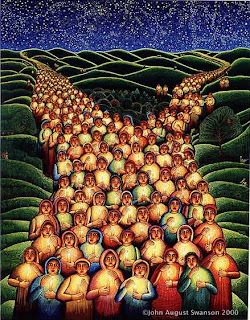

Thursday, November 15, 2007
Fathers and Sons
I really appreciated reading the following article that appeared in the most recent alumni email for Fuller grads:
Slowly but Surely
Slowly but Surely
By Philip Carlson (ThM '93, MDiv '87)
We bring with us into every new day the memories and experiences of the past. For all of us there are parts of our story that are hard to forget: the injustices of life, experiences of being treated unfairly, the times when we were misunderstood, relationships that ended badly with no closure, hurts where no one ever said I'm sorry. How our past impacts our future is largely determined by the way we apply God's grace to our own hearts and the hearts of others.
Emotional healing has come slowly but surely for me through a growing recognition of God's love. The forgiveness I've received and given has helped facilitate the emotional healing that has set me free not to repeat the past. As God gave Carole and me our children, I committed to the Lord that they would grow up in a very different environment than I had. This meant more than avoiding the negative things that can leave lasting wounds in our children, but finding ways to convey the high value I place on each of them and leaving positive memories of a father who loved God by honoring them.
One of the things that I have done periodically over the years is to recite to my children the stories of the days they were born. I describe the events with careful detail, explaining our emotions throughout the day, especially as they were born and we held them for the first time. We may be sitting at home or riding in the car and I will just launch into the story. This is one of my idiosyncrasies of which they have never tired. I love to watch their expressions as I tell their stories. Each of them has favorite parts that I must not exclude. Brendan loves the end of his story the best. As I arrive at that part of the story he gets a look of enthusiasm that says, 'I love this part.' The end of his story goes like this: 'It was almost midnight and I was about to leave the hospital and go home. I decided to go to the nursery to see you one more time. When I got there the nursery was full, but you were front and center and the nurse was taking care of you. A number of people were standing there and several commented on how cute you were. As I stood there I felt so much love and joy that I thought my chest was going to explode and I pointed to you and said, 'That's my boy. That's my boy.''
Years ago I read in Gordon Dalbey's excellent book on the healing of the masculine soul that the thing sons most need to hear from their fathers is not 'I love you,' but the words 'You are my son. You belong to me.'
A couple of years ago, I took Brendan with me to visit someone in the hospital. As we walked holding hands, I said to Brendan, 'I love you, buddy. You are so precious to me. I am so glad that you are my son.' Brendan, who was about six, stopped dead in his tracks, looked up at me and said, 'I love it when you say that.' Now, I had made several statements and wanted to be clear about what he meant. So I asked, 'When I say what?' to which he replied, 'When you say what you just said: 'You are my son.''
'How great is the love the Father has lavished on us, that we should be called children of God!' (1 John 3:1)
Tuesday, November 06, 2007
Life in General
Representatives from a local Christian mission spoke to our congregation last night - trying to help our church understand the needs facing persons with serious addictions or other destructive habits that are ruining their lives. Shortly after enjoying a good plate of ham, potato casserole, green beans, and pineapple upside-down cake, the audience was shown a video with testimonies from people who had used or were using the mission's services. One of the men in the video quoted some advice a staff member had given him as he was in the gutter so to speak: "It isn't that you want to die; you just don't know how to live."
Bullseye. That line lodged itself into my conscience, germinating a number of other thoughts and conversations that lay dormant. How do we live? That is - isn't it - the essence of it all. What path are we intended to follow, what rules are intended to instruct our days?
I also read recently that the Hebrew tradition sought to answer those questions for us. Torah is meant to give instruction for living - all of it. Author A. J. Jacobs - a Jew by birth but not by practice (until recently) - has been making waves by drawing out this conclusion. He literally tried to follow the Bible for an entire year. His sense was that the prescriptions for holy living truly were profitable.
The Christian Scriptures too seek to illuminate a way of life: discipleship or a life-long willingness to follow the pattern of Christ. I have been reconnecting with this reality by tapping into some modern teachers like Dallas Willard and Richard Foster all over again. These two men have put in significant time studying and communicating answers to the question, "How do we live?" Foster in particular has established Renovare - an ecumenical effort to give Christians and churches a deeper appreciation for the long, deep history of others who have sought to answer this question. The resources that Foster and others are producing through Renovare are some of the most helpful and hopeful I've come across in a long time.
Of particular value is the book Streams of Living Water: Celebrating the Great Traditions of Christian Faith. The simple aim of this book is to present clearly how various traditions have tried to live faithfully God's call to be disciples of Christ. According to this study, there are six streams of thought and action: contemplative, holiness, charismatic/spirit-empowered, social justice, evangelical, and incarnational.
As I work with and minister to people of varying social and economic situations, the knowledge of how to live is clearly missing ... and I say that for my own soul much of the time. Our culture is good at determining how to be successful, how to progress, how to compete and win. But, there is very little awareness of how to live a good life - well, aside from the materialistic, shallow definitions given to us through television ads and billboards.
Those streams of culture - or more likely flood waters - are quick to suggest that meaning comes through acquisition and possession. But, the more I read rich souls and study Scripture, the more I get the sense that the good life comes through a deep awareness of God in all of life and through practices and habits that train us to be more deeply and fully aware of God. There is no easy way around it: living well means a good deal of training and preparing to live well. This - I am aware - flies in the face of what Dallas Willard calls "vampire Christianity" where we willingly take the blood of Christ for our forgiveness and peace of mind but abandon a life of decency, justice and holiness as the cross that it is (click here for more; Willard cites A. W. Tozer as the source of this modern heresy).
This takes me back to the voices of homeless men and women I heard last night on the DVD. When you get to the point of homelessness - of being down and out - there really isn't anything you can buy or obtain that will get you out of the pit. At the bottom is only a long, arduous path of recovery, which includes learning all over again how to live: how to manage money, how to say no to destructive forces and yes to positive habits. That's about it. Well, there are two other critical things - two things the Christian tradition holds dearly:
1. The role of the Spirit in leading our regeneration in Christ.
2. The value of community and ceremonies to help us remember that we are not in this alone.
Without those two realities, our efforts - so others have said - amounts to strict legalism, frustration, and ultimately a return to despair.
So, there it is: we all have a need to know how to live well. I guess that's why Joel Osteen can sell a ton of books and why self-help is now quintessentially American. People are dying to live well. And, if someone can promise to help you in that endeavor (especially with an ivory smile), why wouldn't you want to listen. It is even more complicated because there is a great deal of truth in these self-help methods and "positive Christianity" efforts.
But (and I swear this will be the last thing), there is a problem with that stream ... and to illustrate, I want to tell you about Cool Whip.
Cool Whip promises to have 50% less calories than real whipped cream. The assumption here is that you'll consume less calories, but it denies the underlying problem: people don't need less calories; they need a different understanding of how to eat.
In the same way, we don't need better products (specifically new and flashy ones) to live better. What we need are ancient, proven rhythms and postures. To hand ourselves over to the current best seller is to let in any number of "additives" that may just be counterproductive, if not destructive. So, that's it. I just finally had some pieces of the puzzle fall into place after a long period of looking long and hard at disorder.
Shalom,
Wes
Bullseye. That line lodged itself into my conscience, germinating a number of other thoughts and conversations that lay dormant. How do we live? That is - isn't it - the essence of it all. What path are we intended to follow, what rules are intended to instruct our days?
I also read recently that the Hebrew tradition sought to answer those questions for us. Torah is meant to give instruction for living - all of it. Author A. J. Jacobs - a Jew by birth but not by practice (until recently) - has been making waves by drawing out this conclusion. He literally tried to follow the Bible for an entire year. His sense was that the prescriptions for holy living truly were profitable.
The Christian Scriptures too seek to illuminate a way of life: discipleship or a life-long willingness to follow the pattern of Christ. I have been reconnecting with this reality by tapping into some modern teachers like Dallas Willard and Richard Foster all over again. These two men have put in significant time studying and communicating answers to the question, "How do we live?" Foster in particular has established Renovare - an ecumenical effort to give Christians and churches a deeper appreciation for the long, deep history of others who have sought to answer this question. The resources that Foster and others are producing through Renovare are some of the most helpful and hopeful I've come across in a long time.
Of particular value is the book Streams of Living Water: Celebrating the Great Traditions of Christian Faith. The simple aim of this book is to present clearly how various traditions have tried to live faithfully God's call to be disciples of Christ. According to this study, there are six streams of thought and action: contemplative, holiness, charismatic/spirit-empowered, social justice, evangelical, and incarnational.
As I work with and minister to people of varying social and economic situations, the knowledge of how to live is clearly missing ... and I say that for my own soul much of the time. Our culture is good at determining how to be successful, how to progress, how to compete and win. But, there is very little awareness of how to live a good life - well, aside from the materialistic, shallow definitions given to us through television ads and billboards.
Those streams of culture - or more likely flood waters - are quick to suggest that meaning comes through acquisition and possession. But, the more I read rich souls and study Scripture, the more I get the sense that the good life comes through a deep awareness of God in all of life and through practices and habits that train us to be more deeply and fully aware of God. There is no easy way around it: living well means a good deal of training and preparing to live well. This - I am aware - flies in the face of what Dallas Willard calls "vampire Christianity" where we willingly take the blood of Christ for our forgiveness and peace of mind but abandon a life of decency, justice and holiness as the cross that it is (click here for more; Willard cites A. W. Tozer as the source of this modern heresy).
This takes me back to the voices of homeless men and women I heard last night on the DVD. When you get to the point of homelessness - of being down and out - there really isn't anything you can buy or obtain that will get you out of the pit. At the bottom is only a long, arduous path of recovery, which includes learning all over again how to live: how to manage money, how to say no to destructive forces and yes to positive habits. That's about it. Well, there are two other critical things - two things the Christian tradition holds dearly:
1. The role of the Spirit in leading our regeneration in Christ.
2. The value of community and ceremonies to help us remember that we are not in this alone.
Without those two realities, our efforts - so others have said - amounts to strict legalism, frustration, and ultimately a return to despair.
So, there it is: we all have a need to know how to live well. I guess that's why Joel Osteen can sell a ton of books and why self-help is now quintessentially American. People are dying to live well. And, if someone can promise to help you in that endeavor (especially with an ivory smile), why wouldn't you want to listen. It is even more complicated because there is a great deal of truth in these self-help methods and "positive Christianity" efforts.
But (and I swear this will be the last thing), there is a problem with that stream ... and to illustrate, I want to tell you about Cool Whip.
Cool Whip promises to have 50% less calories than real whipped cream. The assumption here is that you'll consume less calories, but it denies the underlying problem: people don't need less calories; they need a different understanding of how to eat.
In the same way, we don't need better products (specifically new and flashy ones) to live better. What we need are ancient, proven rhythms and postures. To hand ourselves over to the current best seller is to let in any number of "additives" that may just be counterproductive, if not destructive. So, that's it. I just finally had some pieces of the puzzle fall into place after a long period of looking long and hard at disorder.
Shalom,
Wes
Thursday, September 27, 2007
The Good Web
Here is a wonderful resource and website: Practicing Our Faith. It includes some good thoughts on various spiritual activities that lead to greater depth and strength of faith. I am also intrigued by the Valparaiso Practice Grant, which seeks to gift groups or organizations that would like to enhance or develop some of these activities.
Wes
Wes
Sunday, September 16, 2007
Bankrupt
Jesus said today that unless I am willing to sell all of my possessions - to sever the bonds of mother and father - that I am not yet ready to be his disciple.
So, I wonder what it is that I am holding onto that keeps me from bankrupting my life to witness greater things than these ...
the fear of not keeping pace with the Jones'
the security of a life that doesn't require much faith
the insecurity of moving beyond professional religion to do God's work
the fear that I will offend or confuse people if I try to live by God's will first and foremost
...
Yeah, that's pretty much about it.
...
Then, later in the day, someone besides Jesus said this:
"worship is meant to comfort the afflicted and afflict the comfortable."
God cuts both ways - taking us down to lift us up, and lifting us up that we might be bowed down low.
Wes
So, I wonder what it is that I am holding onto that keeps me from bankrupting my life to witness greater things than these ...
the fear of not keeping pace with the Jones'
the security of a life that doesn't require much faith
the insecurity of moving beyond professional religion to do God's work
the fear that I will offend or confuse people if I try to live by God's will first and foremost
...
Yeah, that's pretty much about it.
...
Then, later in the day, someone besides Jesus said this:
"worship is meant to comfort the afflicted and afflict the comfortable."
God cuts both ways - taking us down to lift us up, and lifting us up that we might be bowed down low.
Wes
Tuesday, September 11, 2007
Mother Teresa
A compilation of Mother Teresa's letters and journals was recently compiled and published by a Catholic man hoping to bulster Mother Teresa's odds of becoming a saint. This book, Mother Teresa: Come By My Light, has been in the news much since its publication because it opens a new avenue into people's understanding of who this woman was. Or, more succinctly, people are in a stir because Mother Teresa doubted very much God's presence and pleasure in and for her life.
Here is an article from Time magazine about this book and Mother Teresa's dark night of the soul experience.
I hope to write more about her struggles and this article in the coming days. Briefly, though, what left the biggest impression upon me was the different ways other people analyze and critique her faith - from the religious leader to the psychoanalyst to the atheist. I have my own leanings, but I'd be interested to hear your own. What do you make of Mother Teresa's faith and struggles, her consistent humility (some would say groveling), and her inability to access any certainty of God's presence through her feelings?
Wes
Here is an article from Time magazine about this book and Mother Teresa's dark night of the soul experience.
I hope to write more about her struggles and this article in the coming days. Briefly, though, what left the biggest impression upon me was the different ways other people analyze and critique her faith - from the religious leader to the psychoanalyst to the atheist. I have my own leanings, but I'd be interested to hear your own. What do you make of Mother Teresa's faith and struggles, her consistent humility (some would say groveling), and her inability to access any certainty of God's presence through her feelings?
Wes
Monday, September 03, 2007
The Good Samaritan
I have just returned from a two day stay in Nashville where I attended the National Presbyterian Evangelism Conference. This was the first Presbyterian conference focusing on evangelism in 10 years - a fact caused by multiple reasons. Well, actually, it is probably pretty simple: as a denomination we have not had a clear voice about what is "good news" lately.
Jim Wallis - editor and author - was invited to address the 400 or so Presbyterians gathered in the Opryland Hotel. Anna had the chance to hear Jim Wallis at Fuller, but for some reason that I cannot recall I missed it. And, to be honest, I did not read his popular book God's Politics: Why the Right Gets it Wrong and the Left Just Doesn't Get It. So, I was excited to hear his stance and pitch.
Wallis essentially told all of us that what is needed is nothing less than a revival of 19th Evangelical Christianity ... or, in other words, a type of Christianity which is adamantly spiritual but that is also purposefully concerned with social justice. He said we need a "prairie fire" effect. And, to demonstrate his point, he lifted up the example of Charles Finney - the great preacher and prophet who was part of the Second Great Awakening in America.
Now, here's the crazy thing: Finney can not be classified by today's Christian labels. He fits both and neither. For he was ardent in his theology and justice-oriented in his worldview. As Wallis pointed out, it was Finney who began the practice of "altar calls" - that oft used and embarrassing technique we've all experienced at some point. But, here's the kicker: Finney used altar calls so he could sign up and register new believers for his abolition campaigns!
A consuming passion for God and a deep love and interest to create justice: Finney wanted them both.
...
Fabio Saccoriaz - a Cuban immigrant and former acquaintance from my Zionsville days- was also at this conference. He has been doing immigrant ministry in the Indianapolis area for the past six years. His language skills, his interest in immigrants and his experience with day-labor workers and tenant farmers makes him especially gifted for this work. You would think this conference - which was also about multiculturalism and ministering to immigrants - would be perfect for a person like Fabio. And, he was deeply thankful for it ... but not enough to cover his discouragement and exhaustion incurred from doing his work in Indianapolis.
I sat over lunch on Sunday listening to Fabio's struggles these past six years ... about how the Latino population of Indianapolis continues to grow as well as the need for assisting them ... legal help, dentistry, child care, ESL classes, job training. But, those are struggles he wants - needs he can meet. What is truly vexing for him is the lack of support from other Presbyterian churches in the area and from the regional governing board, which blesses his ministry superficially and is quick to claim it has a Latino ministry in Indianapolis but is absent in equipping Fabio's church with pastoral support.
By this point, I am getting worked up, because one of the major churches in the area - Zionsville Presbyterian Church - was my home church. So, I ask Fabio, "What about ZPC? Why aren't they helping?"
Fabio was clearly trying to be diplomatic. He said that yes, without ZPC's funding and assistance, he could never have begun this ministry. But ... I could tell there was a "but." He went on to say that he can't get the people of northern Indianapolis - including the congregation and leadership of ZPC - to engage in the ministry with him. Or, in Fabio's words, "I can get 300 people together for a mission trip down to Mexico, but I can't get more than a dozen people to volunteer for a bilingual VBS week in Indianapolis." Nor can he get more than a handful of dentists to do charitable work or more than one lawyer to do pro bono work. "And I know there's more than one lawyer in Zionsville," Fabio joked. I was not laughing.
Now, I love ZPC, and the pastoral staff at that church have been integral to my own faith journey. I know if they were to hear Fabio speak, they would be crushed and likely penitent. But, the fact of the matter is this: ZPC - and many other evangelical congregations - is too busy trying to be a church unto itself. A church that is doing great ministry, yes, but a church that is becoming more and more isolated. Think of Saddleback or Willow Creek. These type of churches are becoming bastions of Christianity, becoming regional poles but also losing a grip upon local realities. By and large mega-churches are suburban churches, so they inevitably lose contact with the ministry needs and injustices of the city's poor and rural poverty.
I kept thinking of what Fabio said ... about how suburban Christians were eager to travel thousands of miles once a year for the sake of Christ but couldn't engage the poor and overlooked in their own city. "That's the parable of the Good Samaritan," I said - that convicting and ironical tale about the religious leaders who go out of their way to do ministry while ignoring the injured in their path.
Unfortunately, Fabio and a few others are the only good Samaritans in this story. The rest of the church is walking to the other side of the street to do ministry somewhere else.
...
Yeah, it is time for a revival: to see our own streets and local communities with the grace and mercy of Jesus Christ.
Jim Wallis - editor and author - was invited to address the 400 or so Presbyterians gathered in the Opryland Hotel. Anna had the chance to hear Jim Wallis at Fuller, but for some reason that I cannot recall I missed it. And, to be honest, I did not read his popular book God's Politics: Why the Right Gets it Wrong and the Left Just Doesn't Get It. So, I was excited to hear his stance and pitch.
Wallis essentially told all of us that what is needed is nothing less than a revival of 19th Evangelical Christianity ... or, in other words, a type of Christianity which is adamantly spiritual but that is also purposefully concerned with social justice. He said we need a "prairie fire" effect. And, to demonstrate his point, he lifted up the example of Charles Finney - the great preacher and prophet who was part of the Second Great Awakening in America.
Now, here's the crazy thing: Finney can not be classified by today's Christian labels. He fits both and neither. For he was ardent in his theology and justice-oriented in his worldview. As Wallis pointed out, it was Finney who began the practice of "altar calls" - that oft used and embarrassing technique we've all experienced at some point. But, here's the kicker: Finney used altar calls so he could sign up and register new believers for his abolition campaigns!
A consuming passion for God and a deep love and interest to create justice: Finney wanted them both.
...
Fabio Saccoriaz - a Cuban immigrant and former acquaintance from my Zionsville days- was also at this conference. He has been doing immigrant ministry in the Indianapolis area for the past six years. His language skills, his interest in immigrants and his experience with day-labor workers and tenant farmers makes him especially gifted for this work. You would think this conference - which was also about multiculturalism and ministering to immigrants - would be perfect for a person like Fabio. And, he was deeply thankful for it ... but not enough to cover his discouragement and exhaustion incurred from doing his work in Indianapolis.
I sat over lunch on Sunday listening to Fabio's struggles these past six years ... about how the Latino population of Indianapolis continues to grow as well as the need for assisting them ... legal help, dentistry, child care, ESL classes, job training. But, those are struggles he wants - needs he can meet. What is truly vexing for him is the lack of support from other Presbyterian churches in the area and from the regional governing board, which blesses his ministry superficially and is quick to claim it has a Latino ministry in Indianapolis but is absent in equipping Fabio's church with pastoral support.
By this point, I am getting worked up, because one of the major churches in the area - Zionsville Presbyterian Church - was my home church. So, I ask Fabio, "What about ZPC? Why aren't they helping?"
Fabio was clearly trying to be diplomatic. He said that yes, without ZPC's funding and assistance, he could never have begun this ministry. But ... I could tell there was a "but." He went on to say that he can't get the people of northern Indianapolis - including the congregation and leadership of ZPC - to engage in the ministry with him. Or, in Fabio's words, "I can get 300 people together for a mission trip down to Mexico, but I can't get more than a dozen people to volunteer for a bilingual VBS week in Indianapolis." Nor can he get more than a handful of dentists to do charitable work or more than one lawyer to do pro bono work. "And I know there's more than one lawyer in Zionsville," Fabio joked. I was not laughing.
Now, I love ZPC, and the pastoral staff at that church have been integral to my own faith journey. I know if they were to hear Fabio speak, they would be crushed and likely penitent. But, the fact of the matter is this: ZPC - and many other evangelical congregations - is too busy trying to be a church unto itself. A church that is doing great ministry, yes, but a church that is becoming more and more isolated. Think of Saddleback or Willow Creek. These type of churches are becoming bastions of Christianity, becoming regional poles but also losing a grip upon local realities. By and large mega-churches are suburban churches, so they inevitably lose contact with the ministry needs and injustices of the city's poor and rural poverty.
I kept thinking of what Fabio said ... about how suburban Christians were eager to travel thousands of miles once a year for the sake of Christ but couldn't engage the poor and overlooked in their own city. "That's the parable of the Good Samaritan," I said - that convicting and ironical tale about the religious leaders who go out of their way to do ministry while ignoring the injured in their path.
Unfortunately, Fabio and a few others are the only good Samaritans in this story. The rest of the church is walking to the other side of the street to do ministry somewhere else.
...
Yeah, it is time for a revival: to see our own streets and local communities with the grace and mercy of Jesus Christ.
Thursday, August 30, 2007
Mysticism through Immersion
"I have come to believe that the true mystics ... are not those who contemplate holiness in isolation ... but those who manage to find God in a life filled with noise, the demands of other people and relentless daily duties that can consume the self. They may be young parents juggling child-rearing and making a living ... If they are wise, they treasure the rare moments of solitude and silence that come their way, and use them not to escape, to distract themselves with television and the like. Instead, they listen for a sign of God's presence and they open their hearts towards prayer." - Kathleen Norris as quoted in Eugene Peterson's Eat This Book.
Tuesday, July 31, 2007
Music
Hey, everyone. I am ready once again to stretch my musical awareness (which usually means some minor purchases on iTunes). So, if you have any ideas how I should spend $20 or so, let me know.
...
In other news, Ingmar Bergman died this week - film maker and philosopher. His most famous film is The Seventh Seal, which involves a medieval knight playing chess with death:

Anyhow, I've been co-leading a bible study on Revelation for our church, and - wouldn't you know it - this weeks study has us looking at Revelation 8:1 ... about the seventh seal. Clearly this is true evidence that history is now nearing its fulfillment.
Anna and I watched The Seventh Seal not too long ago ... actually, I think I was the only one to make it through that one. I remember being bored at times by the heavy imagery and overt philosophy, but I loved the overall message. In short, it is about the triumph of love and faith over despair, death and disbelief.
Wes
...
In other news, Ingmar Bergman died this week - film maker and philosopher. His most famous film is The Seventh Seal, which involves a medieval knight playing chess with death:

Anyhow, I've been co-leading a bible study on Revelation for our church, and - wouldn't you know it - this weeks study has us looking at Revelation 8:1 ... about the seventh seal. Clearly this is true evidence that history is now nearing its fulfillment.
Anna and I watched The Seventh Seal not too long ago ... actually, I think I was the only one to make it through that one. I remember being bored at times by the heavy imagery and overt philosophy, but I loved the overall message. In short, it is about the triumph of love and faith over despair, death and disbelief.
Wes
Subscribe to:
Posts (Atom)


 Posts
Posts

